LEED Green Associate Exam Brain Dump & Takeaways

The LEED Green Associate exam is a professional credentialing exam administered by Prometric.

About the Prometric Testing Center

The morning I went to take my exam, Prometric had server issues and had to dismiss half of the candidates at the center because their computers would not load the exam (ouch, that’s painful). Luckily, my computer was not one of them. Overall, the testing center was a bit chaotic when I arrived. Aside from the obviously upset group of people above, there was a gentleman in front of me from South America who had four names listed in his passport but only two names listed in the Prometric system. They were not going to let him test, and he was very upset. Once they moved him off the front desk, I sailed right in. The Prometric communications had recommended that I arrive 30 minutes early, and I see why. I got there at 8 a.m. and wound up waiting in line and signing in at 8:22 after all of the drama. Interestingly, the Prometric proctor told me that she recommended that I utilize my scrap paper to do a brain dump during the ten-minute tutorial. I have heard experiences before where people were told that they were not allowed to do a brain dump.

About the LEED Green Associate Exam Structure

The exam was 100 questions in 2 hours. There is a calculator on the exam now, but I did not have to use it at all. There was the tutorial 10 minutes prior to the exam, and I actually took the post-exam survey, which was about the Prometric testing center experience. Overall, the structure was exactly what the candidate handbook said it would be.

About the LEED Green Associate Exam Questions

80% of this LEED exam was single-answer multiple choice with exactly four choices. The remaining 20% was multiple-answer, multiple choice with choose 2 or 3 out of 4 or 5 answers. Many of the questions were very straightforward, and I finished my first pass at all of the answers in 58 minutes before returning to review the questions. The LEED Green Associate exam tested all of the LEED concepts at a very broad level. In some ways, the LEED Green Associate might actually be harder to study for since there is no credit framework within which to memorize or structure the information. 90% of the questions were very straightforward but also very in-depth. There were lots of refrigerant questions and down to the name and number of the refrigerants to use (wow, who has that memorized). The remaining 10% were tricky because of things like a double negative or because the wording was vague, and I had to read the question multiple times to even figure out what the exam was asking for (maybe it was a poorly worded question). I was actually amazed at the level of background knowledge required for this exam. There is no magic formula or LEED percentages to memorize but rather you’ll have to become well versed in all of the LEED green building topics in order to answer the questions on this exam.

Interestingly enough, the exam referred quite a bit to credit categories (Sustainable Sites, Water Efficiency, etc) and to credits themselves (Daylight, Fundamental Refrigerant Management, etc). I had not expected this on the exam since I assumed the LEED Green Associate was testing general knowledge and not any one rating system. I find this interesting because most people taking the LEED Green Associate probably would not have studied any one rating system in depth enough to know which categories allow Innovation in Design and which LEED credits were LEED prerequisite credits (so start studying a rating system).

I scored a 187 on the exam which was surprising to me because I didn’t think that there were any questions that I didn’t know or couldn’t answer. Maybe some of them were trickier than I thought, and I chose the wrong answer without even realizing it.

How to Prepare for the LEED Green Associate Exam

Overall, I still believe that a live instruction course is the best way to prepare for any of the LEED exams. In two days, we are able to cover so much of the material and really explain all of the core concepts. I know from my own experience before teaching sustainability and LEED that studying for the exam had me feeling like I was swimming a bit in a sea of knowledge unsure about what was important and exactly how many of the credit areas really worked. Now I love to see the “aha” moments that students in class have when we explain a concept (like light pollution’s “interior angle of maximum candelas must strike opaque interior surfaces” can be simply stated as “don’t shine your lights out windows at night”). If you are taking the LEED Green Associate Exam, I would highly recommend taking an Everblue LEED Green Associate Prep Course.

Register now for LEED Green Associate Exam Prep

LEED AP EBOM Exam Prep Available for Facility Management Staff

The U.S. Green Building Council’s LEED certification for buildings is the gold standard for green buildings in the United States and around the world. LEED Accredited Professionals (LEED AP) are recognized experts in LEED that can navigate the green building process and help buildings attain LEED Certification. Thus, LEED AP EBOM takes it a step further, enabling LEED AP professionals to specialize in a specific version of LEED. In this case, EBOM represents Existing Buildings Operations + Maintenance.

LEED AP O+M Training

As green building goes mainstream, professionals from all backgrounds are seeking the coveted LEED AP title by taking the U.S. Green Building Council’s LEEP AP Exam. The exam, however, has a notoriously low pass rate and is scheduled to double in length after March 31, 2009 from two to four hours. With a staff experienced in both green building and test preparation, Everblue Training Institute has developed exam preparation classes designed both to inform students about the basics of LEED and to help them pass the exam. As the LEED New Construction (LEED-NC) and LEED Commercial Interiors (LEED-CI) exams retire on March 31, 2009, Everblue will be ready on April 1 to offer test prep classes for the next generation of the standard: LEED 2009. LEED O+M is the first of five exams that will become available throughout 2009, and Everblue plans to have courses available for each as they become available.

After an overwhelming initial response for its training, Everblue’s LEED Exam courses are now available in Atlanta, Austin, Boston, Charlotte, Chicago, Dallas, Denver, Irvine, Las Vegas, Los Angeles, Miami, New York City, Portland, Raleigh, Sacramento, San Diego, San Francisco, Seattle, and Washington, DC. The company plans to continue expanding its offerings into other major U.S. markets in throughout 2009 and will begin offering LEED AP EBOM Exam Prep courses in the spring of 2009 as the new exam becomes available.

LEED AP Salary: What to Expect for Various Construction Professionals

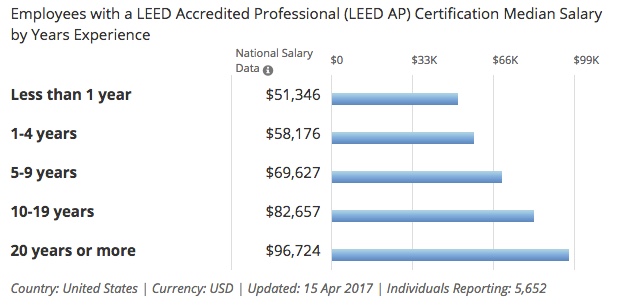
We get asked all the time what career or business opportunities are involved once a person achieves LEED AP Certification. This is an interesting question. We could answer by posting the following chart that I came across this evening. It is the supposed LEED AP salary that you might expect to earn after getting accredited:

leed accredited professional salary by years experience

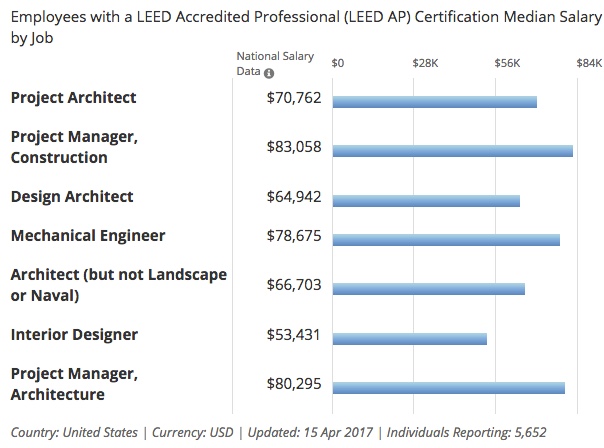
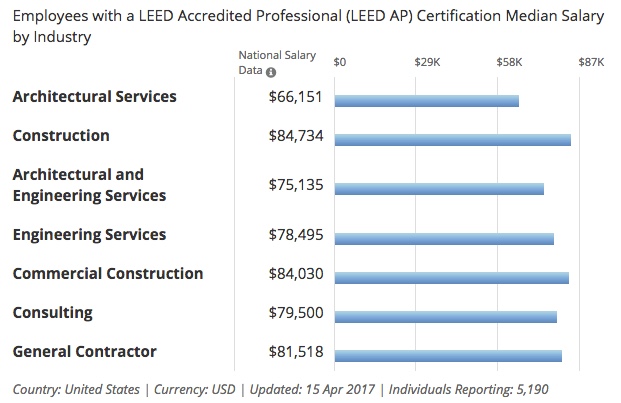
Well, as neat as the above chart is, it kind of misses the point because those aren’t the ONLY LEED AP jobs available. Those are traditional construction design jobs! Granted we are seeing many construction projects that now require all sub-contractors to have a LEED AP on staff so that they understand the sustainability requirements. The traditional construction industry jobs will definitely be very important in the future, but to say that they are the only ones that need LEED Certification misses the point.

median leed accredited professional salary by job

We’ve trained concrete contractors that now realize that their waste wood form work is part of what makes the current construction standards unsustainable. So now I know a company that’s advertising as a LEED Concrete company by offering to use Forest Certified Plywood and Lumber on form-work, by recycling as much wood as possible from project to project, by utilizing central wood cutting areas, by utilizing high recycled concrete, etc. At the end of the day, that company has created a niche because they are reducing waste and utilizing resources more efficiently.

leed accredited professional salary by industry

We’ve trained construction demolition companies that now specialize in recycling or reusing job site materials to reduce landfill waste and to help other job sites achieve material reuse credits.

We’ve trained all sorts of people that now understand the concept of Heat Islands, Ventilation, Day-lighting, Thermal Control, Waterless Urinals, Rainwater Harvesting.

LEED Offers Monetary & Intangible Value

LEED is an all encompassing sustainability standard that offers many niches for individuals to create VALUE by offering a more resource-efficient product or service. It’s about more than just a LEED AP salary; it should be about your passion for sustainability and doing what’s right for the triple bottom line – people, planet, and profits.

But, for the sake of argument, let’s still look at what opportunities does getting LEED Certification provide. What we believe is that sustainable, resource-efficient development (think energy, water, and air quality) represents the future of this country. Sustainability is fast becoming a required design criteria for all sorts of products, not just the building industry. Whether you have construction industry experience or not, LEED certification is a starting point for understanding the opportunities available as the green industry takes off.

To learn more about becoming a LEED AP, consider taking one of our Everblue LEED Exam Prep Courses.

LEED Exam Feedback & Speculation on Pass Rates

I’ve read quite a bit of LEED exam feedback lately, mostly speculation about exam pass rates and the new LEED standards. The unofficial consensus seems to be that the USGBC intends to push the pass rates for the LEED exams down by making the exam harder and asking more detailed questions. The intent seems to be to maintain the integrity of the standard.

Is LEED’s Marketability at Risk?

With the massive increases in people taking the exam and becoming LEED APs, the LEED accreditation risks getting watered down in the sense that if everyone has it, then the standard is no longer something special or something to be valued.

On the flip side, the mission of the USGBC is to spread the green building standards as far and wide as possible. In many ways, their challenge for both LEED-certified buildings and individuals will be to maintain the special nature of LEED, which makes it attractive as a distinguisher in the market place while also becoming more prevalent.

It’s certainly a double-edged sword.

And as a third point, how can we make a sweeping declaration about the difficulty of the LEED exam without knowing more information about the demographic taking the exam? For example, exam pass rates will differ greatly depending on whether a candidate has LEED project experience, whether he/she studied for 1 hour versus 30 hours, and whether he/she is a good test-taker. The pass rate may not have anything to do with USGBC intentionally making the exam harder to preserve its integrity. It seems that someone out there is trying to get folks riled up; now is the perfect time, with the new LEED standards on their way.

I digress; the real point of this post is to ask for feedback from readers about what they’ve heard while attending USGBC workshops about the current LEED exam pass rates and what the new LEED standards will bring.

Become LEED Certified: Do You Need an Engineering Degree?

A potential student sent this question about how to become LEED Certified. The answer, of course, is that a person does not need to be an engineer or have an engineering degree. Similarly, a person does not need to be an architect, a lawyer, a designer, a builder, a developer, or a contractor. The LEED exam is for anyone interested in learning how to make our society’s livable spaces more sustainable.

I think most people confuse LEED with an architectural standard. However, the LEED Rating System was created by a third-party non-profit organization called the U.S. Green Building Council. Sure, LEED largely affects architects. But it’s not purely meant for architects. It really is more than that, and it affects everyone in the building industry.

All you have to do to become LEED certified is pass the LEED professional exam. Granted, you really should sign up for a LEED Exam Prep course to gain a thorough understanding of the test material.

For more information about how you can qualify for the LEED exam, check out the LEED Green Associate Candidate Handbook on the USGBC website.

Engineers (and engineering students) are a great audience for LEED, however. While an engineering degree is not a requirement, those interested in engineering are a natural fit for the LEED skill set. You’ll gain a better understanding of how to design and build green buildings. What’s great about LEED is that it takes into account a wide range of building strategies and building types. It’s a skill set that can be universally applied. 

LEED offers something for everyone – civil engineers, structural engineers, environmental engineers, etc. 

Whether you are interested in engineering or simply interested in sustainability, the LEED skill set is likely the perfect fit for you. Please give us a call at (800) 460-2575 to discuss your passion in greater depth, and we’ll guide you to the right LEED training course.

Register now for LEED Green Associate

LEEDS Certification vs. LEED Certification: Which is Correct?

The first part of my title above is not a typo. Many folks search for LEEDS, LEEDS AP, or LEEDS Certification in Google. When I first started hearing this, I thought it was just a Southern California thing or maybe even just a Los Angeles or Orange County thing, but now I’m hearing people from New York and Texas say LEEDS instead of LEED. Is there a resource on the web that has mistaken LEED for LEEDS, or is it just that people have a natural tendency to add an “s” to the standard? Actually, I wonder if people are familiar with Leeds because of the UK…

If you are, in fact, looking for information about LEED certification, then you should know that the LEED green building standard is administered by the USGBC. That’s the United States Green Building Council, which is both a national and local chapter organization. Now, if you want to become LEED certified, well, that’s a job for GBCI. The Green Business Certification Institute doesn’t actually administer the test, though. So if you want to become LEEDS certified (Oh, I mean LEED certified), you’ll actually have to take the exam through a Prometric testing center. Prometric is a company that specializes in test administration and third-party proctoring.

Anyway, I haven’t even delved into what LEED NC, CI, EB, ND, H, etc. means. That will be a topic for another day! I just wanted to take a moment to say that it’s funny how someone new to LEED generally asks for LEEDS Certification. This is exactly why Everblue’s LEED training course exists – to help newcomers understand the LEED terminology and gain the knowledge and confidence to pass their LEED exam! 

If you have any other questions about LEED terminology or simply how it works, give us a call at (800) 460-2575 and we’ll help you out!